
Changing Perspectives... on Lunar New Year and Cultural Nuances
The MFA DE&I Council would like to see an industry where everyone can thrive, feel heard, supported, and safe to do their best work. Let’s meet the Changers who are sharing their own lived experiences to inspire us all to change for the better.
Changing Perspectives... Lunar New Year (or Chinese New Year?)
Charles Xu, Diverse Director, OMD
You may be thinking: Another Lunar New Year article?! It’s already March!
I get it. The lanterns have come down, the decorations have returned to storage, and most brands have moved on to the next multicultural moment.
But the Lunar New Year conversation wasn’t just about celebrations this year. It intensified.
It all started in 2025, that Chinese tea brand CHAGEE issued an apology after facing backlash for using the phrase “Lunar New Year” instead of “Chinese New Year” on social media.
This year in Australia, posts from major broadcasters ABC and SBS celebrating Lunar New Year drew waves of negative comments, with many debating the terminology. Some people from Chinese backgrounds argued strongly that the festival should be recognised as Chinese New Year, citing its historical origins in China. In SBS’s case, the reactions escalated to the point where posts had to be removed (see images below).
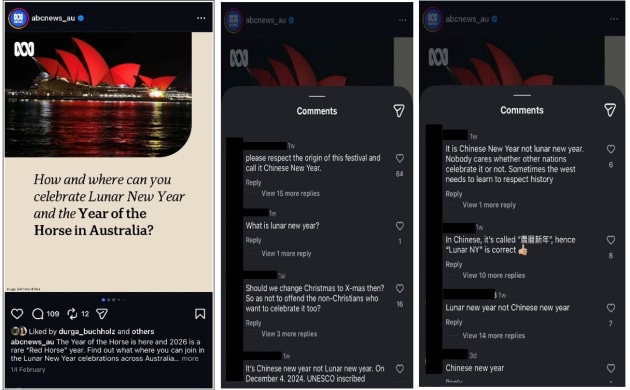
What began as a cultural celebration quickly became a cultural flashpoint.
For communications professionals, the question is not simply whether we should call it “Lunar New Year” or “Chinese New Year”. The more important question is what caused the reaction in the first place.
For many Chinese people, the response reflects a sense of cultural pride. The festival’s origin, traditions and customs trace back thousands of years in China. When the term “Chinese New Year” is replaced in public messaging, many interpret it as a loss of cultural recognition.
But the conversation becomes more complex in multicultural societies.
Across Asia, the same lunisolar calendar evolved into different celebrations, such as Tết in Vietnam, Seollal in Korea, and others. In that context, “Lunar New Year” emerged as an inclusive umbrella term acknowledging multiple traditions.
And this is where the tension sits.
For many Chinese audiences, “Lunar New Year” can feel like cultural erasure. For others, using “Chinese New Year” as a blanket term overlooks the identities of other Asian communities. Both perspectives are rooted in identity and belonging.
None of this means one side is right and the other is wrong. It simply shows how extremely complex cultural conversations can be.
My bigger concern is something else entirely: brands getting cold feet.
If every attempt to acknowledge a cultural moment risks backlash from one side or another, the easiest response is silence. But avoiding cultural celebrations is not the answer. It simply pushes multicultural communities further away from mainstream communications.
Instead, this moment should challenge our industry to develop a higher level of cultural intelligence.
Diversity can’t be approached with a single label or message. Cultural intelligence requires understanding audience, platform and context before choosing the language. Sometimes the most inclusive approach is not picking one universal term but recognising multiple traditions side by side.
In an increasingly diverse Australia, cultural conversations will always be a little messy. But that is exactly why brands should not step away from them, but instead, step up to them.
If this topic sparks thoughts about how we approach cultural nuance in campaigns, I always welcome a conversation. Comment below or find me on Linkedin.
To broaden your understanding of DE&I, complete the SBS Core Inclusion course – Australia’s leading online DE&I training course – available for free to MFA member employees.